
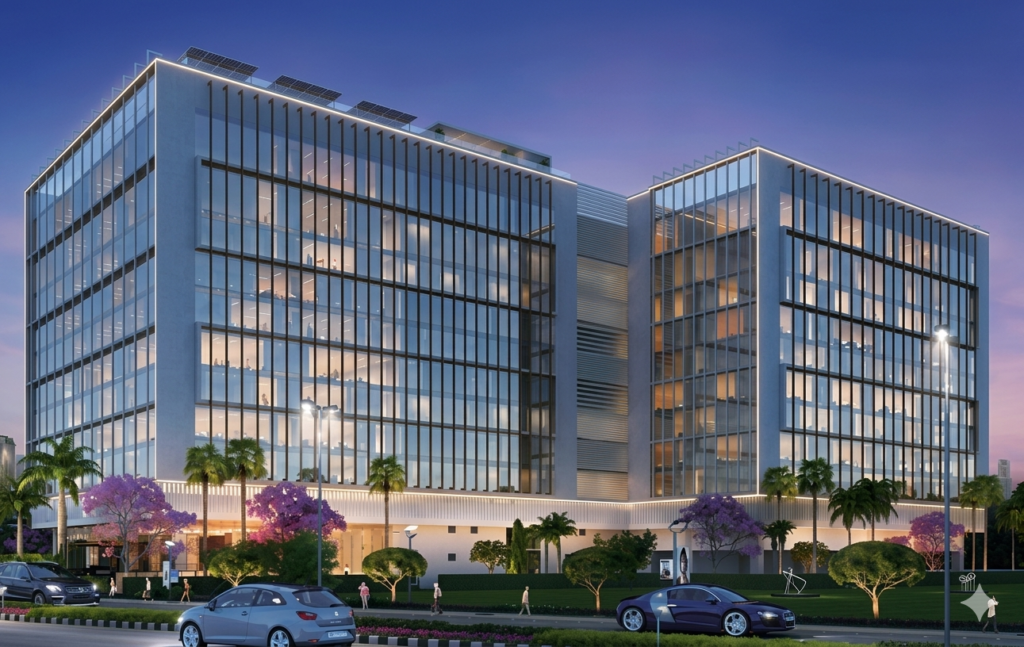
Hyderabad has rapidly transformed into one of India’s most dynamic commercial real estate destinations. A powerful mix of technology-driven growth, infrastructure expansion, and policy support has positioned the city ahead of traditionally dominant metros. While cities like Mumbai and Bengaluru face saturation and rising costs, Hyderabad continues to offer a rare balance of scale, efficiency, and long-term opportunity.
IT & Tech Growth Powering Demand
Often referred to as “Cyberabad,” Hyderabad has become a preferred base for global technology leaders. Companies like Google, Microsoft, Amazon, and Apple have established large campuses across HITEC City, Gachibowli, and the Financial District.
This concentration of global firms has created sustained demand for Grade-A office spaces, leading to consistently high occupancy rates. In recent years, Hyderabad has captured a significant share of India’s Global Capability Centres (GCCs), reinforcing its status as a long-term commercial powerhouse.
Infrastructure That Enables Scale
Hyderabad’s infrastructure is built for growth—not just for today, but for the next decade. Developments such as Rajiv Gandhi International Airport, the Outer Ring Road, metro rail expansion, and the Strategic Road Development Plan (SRDP) have transformed connectivity across the city.
Emerging micro-markets like Kokapet, Nanakramguda, and Tellapur are witnessing rapid commercial expansion. With projections indicating nearly 200 million sq. ft. of additional office space by 2030, Hyderabad is scaling at a pace few cities can match.
Affordability with Strong Growth Potential
One of Hyderabad’s biggest advantages is its cost efficiency. Compared to cities like Mumbai or Bengaluru, commercial spaces here are priced more competitively while offering comparable—if not better—growth prospects.
This pricing advantage attracts a wide range of occupiers—from startups to multinational corporations—driving steady leasing activity. For investors, this translates into consistent rental demand and long-term capital appreciation without the entry barriers seen in other metros.
Policy-Driven Business Environment
The state government has played a critical role in shaping Hyderabad’s growth story. Initiatives like TS-iPASS provide single-window clearances, significantly reducing project timelines.
Additionally, policies supporting FDI, SEZ development, and industrial corridors have encouraged investments across sectors. Large-scale projects such as Hyderabad Pharma City and National Investment and Manufacturing Zones (NIMZs) are further diversifying the city’s economic base.
A Diversified and Future-Ready Economy
Hyderabad is no longer just an IT hub—it is evolving into a multi-sector economic engine. Industries such as pharmaceuticals, finance, aerospace, and logistics are expanding rapidly, supported by a skilled workforce and a strong urban ecosystem.
With projections estimating the city’s economy to reach $200+ billion by 2035, Hyderabad is positioned for sustained, long-term growth. The rise of green buildings, integrated developments, and mixed-use commercial hubs also ensures resilience and adaptability in changing market conditions.
Strategic Takeaway
For developers, investors, and real estate professionals, Hyderabad presents a compelling case: a city that combines infrastructure readiness, corporate demand, and policy support—all while maintaining cost advantages.
For firms like Viseshta Avenues, this isn’t just a growth phase—it’s a strategic window to position premium commercial assets in a market that is still expanding, not peaking.