
Introduction
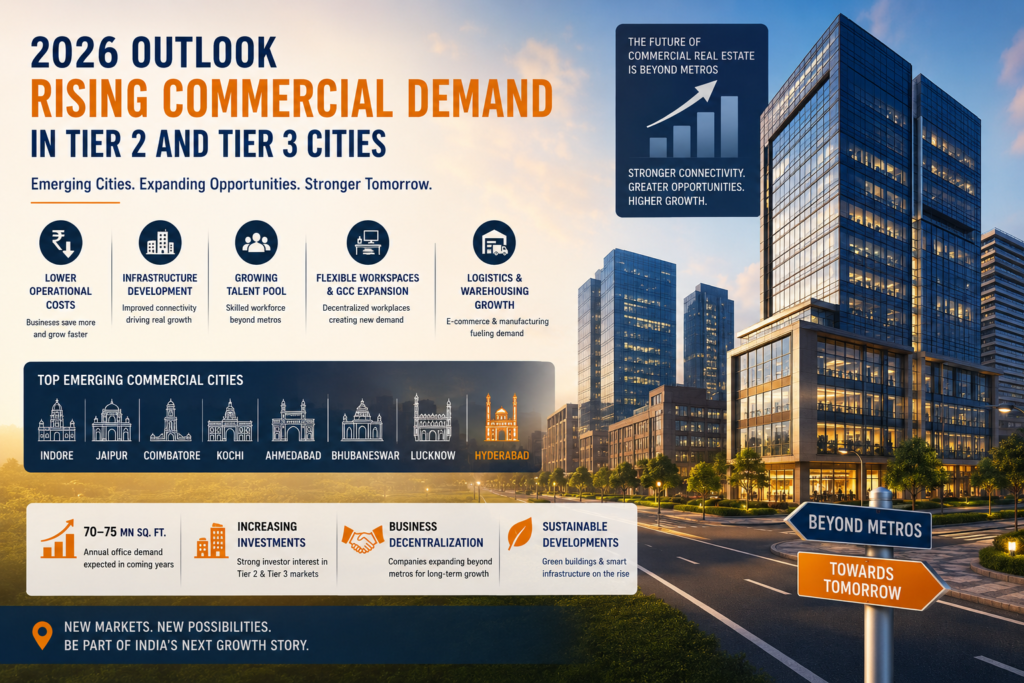
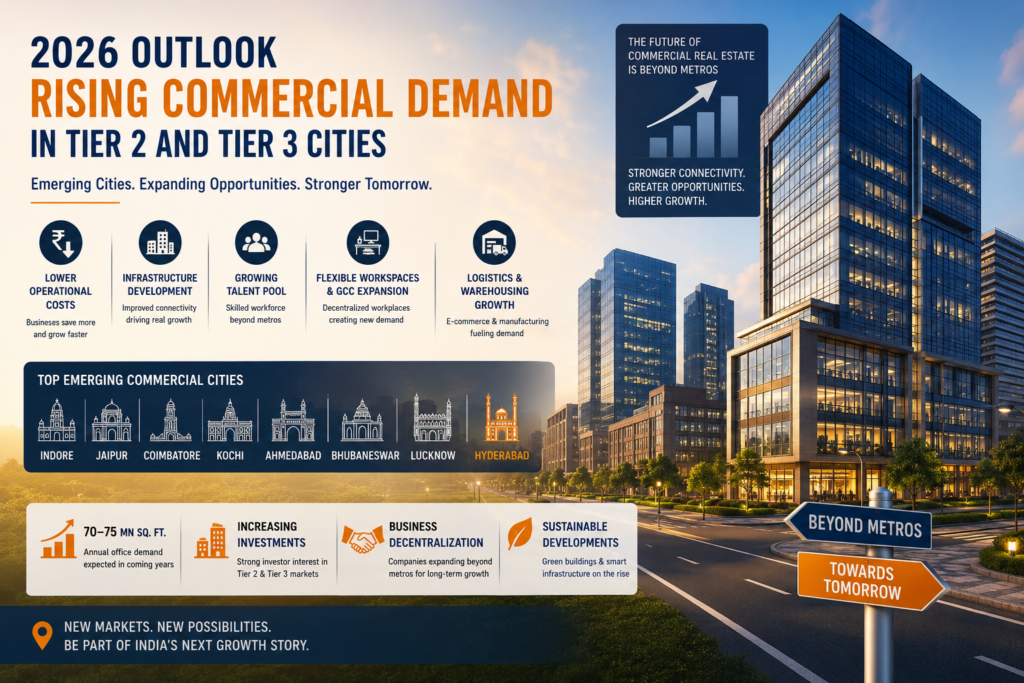
India’s commercial real estate sector is entering a powerful new growth phase in 2026. While metro cities continue to dominate office leasing and corporate expansion, Tier 2 and Tier 3 cities are rapidly emerging as major commercial hotspots.
Businesses are no longer focusing only on cities like Mumbai, Bengaluru, Delhi, Pune, and Hyderabad. Companies are now actively exploring smaller cities for office spaces, retail developments, warehousing hubs, coworking centers, and commercial investments.
Improved infrastructure, lower operational costs, rising talent pools, and government-backed urban development are transforming emerging cities into strong business destinations. Cities like Indore, Jaipur, Coimbatore, Kochi, Ahmedabad, Surat, Bhubaneswar, and Lucknow are witnessing increasing demand for commercial real estate.
At the same time, Hyderabad continues to play a major role in shaping commercial growth across South India through its expanding IT ecosystem, infrastructure projects, and business-friendly environment.
Why Tier 2 and Tier 3 Cities Are Becoming Commercial Hotspots
1. Lower Operational Costs for Businesses
One of the biggest reasons businesses are expanding into smaller cities is cost efficiency. Commercial rentals, employee expenses, and operational costs are significantly lower compared to metro cities.
For startups, SMEs, IT companies, and flexible workspace operators, Tier 2 cities offer scalable growth opportunities without the high overhead costs associated with major metropolitan areas.
This affordability is encouraging businesses to establish:
- Satellite offices
- Regional headquarters
- Customer support centers
- Warehousing facilities
- Managed office spaces
As businesses continue optimizing costs, demand for premium commercial spaces in emerging cities is expected to rise further in 2026.
2. Infrastructure Development Is Driving Growth
Infrastructure expansion is transforming the commercial real estate landscape across India.
Government initiatives such as:
- Smart Cities Mission
- PM Gati Shakti
- Industrial Corridor Projects
- Metro Rail Expansion
- Airport Connectivity Projects
are improving transportation, logistics, and urban connectivity in smaller cities.
New expressways, highways, airports, and industrial parks are making Tier 2 and Tier 3 cities more accessible for businesses and investors.
Improved connectivity is directly increasing demand for:
- Office spaces
- Retail developments
- Logistics hubs
- Industrial parks
- Commercial mixed-use projects
3. Growing Talent Pool and Reverse Migration
Post-pandemic work culture has changed how companies approach expansion. Many professionals now prefer living in affordable cities closer to their hometowns rather than relocating to crowded metro cities.
This shift has created a growing skilled workforce in emerging cities.
Businesses are responding by expanding into Tier 2 locations to access talent while reducing operational costs.
Industries actively expanding into smaller cities include:
- Information Technology
- FinTech
- Healthcare
- Education Technology
- Customer Support Services
- Logistics and Supply Chain
As employment opportunities increase, commercial space demand naturally grows alongside them.
4. Rise of Coworking and Flexible Office Spaces
Flexible workspace operators are rapidly entering Tier 2 and Tier 3 markets.
Startups, remote teams, freelancers, and growing companies are creating strong demand for:
- Coworking spaces
- Managed office solutions
- Shared commercial hubs
- Business centers
Companies are increasingly adopting decentralized office strategies instead of depending only on one metro headquarters.
This trend is boosting office leasing activity in smaller cities across India.
5. Warehousing and Logistics Demand Is Increasing
India’s e-commerce and manufacturing sectors are expanding rapidly. This growth is increasing demand for warehousing and logistics infrastructure in emerging cities.
Tier 2 and Tier 3 locations offer:
- Lower land costs
- Better regional connectivity
- Faster last-mile delivery potential
- Large-scale industrial development opportunities
Businesses are actively investing in:
- Warehousing facilities
- Distribution centers
- Industrial parks
- Logistics hubs
- Data centers
Commercial real estate linked to logistics and supply chains is expected to witness major growth in 2026.
Hyderabad’s Growing Influence on Commercial Expansion
While smaller cities are gaining momentum, Hyderabad remains one of India’s strongest commercial real estate destinations.
The city’s rapid corporate expansion is influencing surrounding regions and nearby emerging business hubs.
Why Hyderabad Continues to Lead Commercial Growth
Strong IT and Corporate Ecosystem
Hyderabad has established itself as a global business and technology hub. Areas like:
- HITEC City
- Financial District
- Kokapet
- Gachibowli
continue attracting multinational companies, startups, and Global Capability Centers (GCCs).
This consistent business expansion is increasing commercial demand across office spaces, retail corridors, and integrated business ecosystems.
Infrastructure Supporting Regional Growth
Hyderabad’s large-scale infrastructure projects are strengthening regional connectivity and commercial development.
Major projects include:
- Outer Ring Road (ORR)
- Regional Ring Road (RRR)
- Hyderabad Metro Expansion
- Airport Connectivity Corridors
- IT and Pharma Investment Zones
These developments are improving access to nearby cities and industrial corridors, creating additional commercial growth opportunities.
Rising Demand for Premium Commercial Spaces
Hyderabad continues witnessing strong demand for:
- Grade-A office spaces
- Commercial towers
- Managed workspaces
- Retail developments
- Mixed-use commercial projects
Prime business locations like Kokapet and Financial District are becoming major commercial investment destinations because of their long-term growth potential.
Top Emerging Commercial Cities in India for 2026
Indore
Indore is attracting startups, IT firms, and retail developments because of its infrastructure and business-friendly environment.
Jaipur
Jaipur’s smart city projects and growing connectivity are driving demand for office and retail spaces.
Coimbatore
Coimbatore is becoming a major commercial hub in South India due to manufacturing and IT sector growth.
Kochi
Kochi is witnessing increased demand from logistics companies, technology firms, and coworking operators.
Ahmedabad
Ahmedabad’s industrial expansion and connectivity projects are strengthening commercial real estate demand.
Bhubaneswar
Bhubaneswar is emerging as a growing IT and business services destination with increasing office leasing activity.
Future of Commercial Real Estate in India
The commercial real estate market in India is no longer limited to metro cities.
Tier 2 and Tier 3 cities are becoming the next major growth engines because of:
- Infrastructure expansion
- Business decentralization
- Affordable commercial investments
- Rising corporate demand
- Growing workforce availability
Developers are now focusing on:
- Grade-A office projects
- Integrated commercial ecosystems
- Smart business parks
- Sustainable developments
- Mixed-use commercial infrastructure
As businesses continue expanding beyond metros, emerging cities are expected to play a major role in India’s economic and commercial growth story over the next decade.
Conclusion
The future of India’s commercial real estate market is rapidly evolving in 2026. Tier 2 and Tier 3 cities are attracting strong commercial demand because of affordability, infrastructure growth, and expanding business ecosystems.
At the same time, Hyderabad continues strengthening its position as one of India’s leading commercial hubs through its IT growth, infrastructure expansion, and premium office developments.
For investors, developers, and businesses, this combination of metro expansion and emerging city growth presents one of the strongest commercial real estate opportunities in the coming years.
FAQs
Why are Tier 2 and Tier 3 cities growing in commercial real estate?
Tier 2 and Tier 3 cities are growing because of lower operational costs, infrastructure development, better connectivity, and increasing business expansion beyond metro cities.
Which sectors are driving commercial demand in smaller cities?
IT companies, logistics firms, coworking operators, manufacturing industries, retail businesses, and Global Capability Centers (GCCs) are driving commercial growth in emerging cities.
Is Hyderabad a good city for commercial real estate investment in 2026?
Yes, Hyderabad remains one of India’s top commercial investment destinations because of its IT ecosystem, infrastructure growth, and rising demand for premium office spaces.
Which cities are emerging as commercial hubs in India?
Cities like Indore, Jaipur, Coimbatore, Kochi, Ahmedabad, Bhubaneswar, Surat, and Lucknow are emerging as strong commercial growth centers.
Why are businesses expanding beyond metro cities?
Businesses are expanding beyond metro cities to reduce operational costs, access skilled talent, and explore affordable commercial infrastructure.
How is infrastructure impacting commercial real estate growth?
Infrastructure projects such as highways, airports, metro rail systems, industrial corridors, and ring roads are improving connectivity and attracting businesses to emerging cities.
What types of commercial properties are in demand in 2026?
The highest demand is expected for:
- Grade-A office spaces
- Coworking spaces
- Retail developments
- Warehousing facilities
- Logistics parks
- Mixed-use commercial projects