
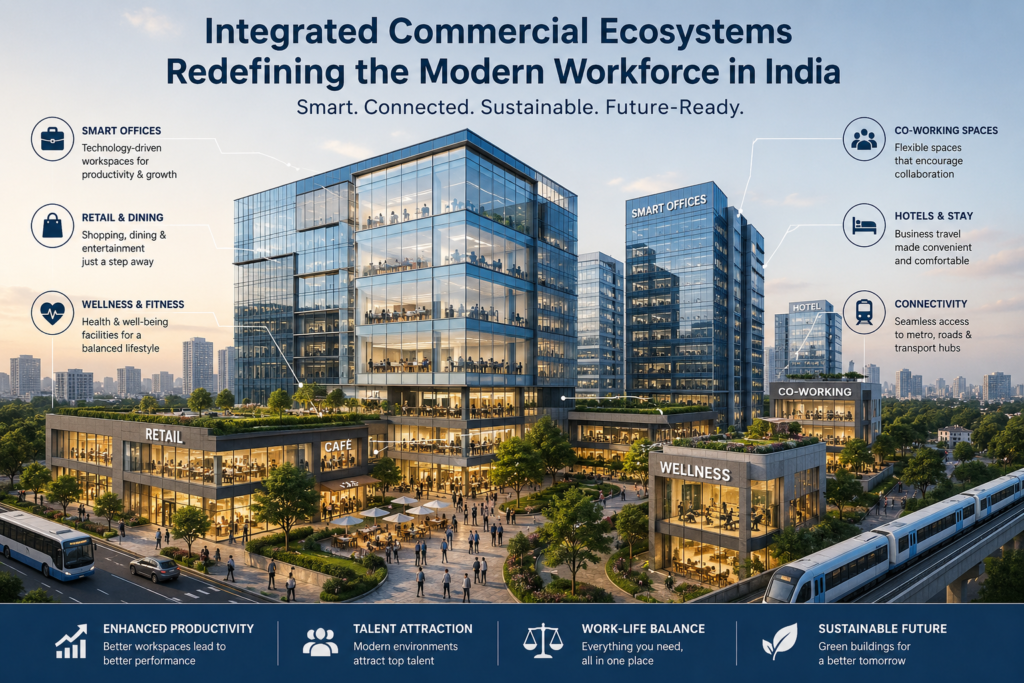
India’s workforce is changing faster than ever. The traditional office model — where employees travel long distances to isolated corporate buildings — is gradually giving way to a smarter, more connected way of working. Today, businesses are looking beyond just office spaces. They want environments that improve productivity, employee well-being, accessibility, collaboration, and overall business growth.
This shift has led to the rise of integrated commercial ecosystems — large-scale developments that combine offices, retail spaces, food courts, hotels, healthcare, entertainment, co-working hubs, and lifestyle amenities within one connected environment.
Cities like Hyderabad, Bengaluru, Pune, and Gurugram are rapidly becoming examples of this transformation, where commercial spaces are no longer just workplaces — they are becoming complete business ecosystems.
What Is an Integrated Commercial Ecosystem?
An integrated commercial ecosystem is a strategically designed business environment where multiple services and facilities work together in one location. Instead of separate office buildings disconnected from daily necessities, these ecosystems create a seamless experience for employees, companies, clients, and visitors.
A modern commercial ecosystem may include:
- Premium office spaces
- Retail outlets and shopping areas
- Cafes and restaurants
- Co-working and collaboration zones
- Hotels and serviced apartments
- Healthcare facilities
- Fitness centers and recreational spaces
- Public transport connectivity
- Green open areas and smart infrastructure
The goal is simple: create a self-sustaining environment where businesses and employees can thrive together.
Why India Is Moving Towards Integrated Commercial Ecosystems
1. Changing Workforce Expectations
Today’s employees prioritize convenience, flexibility, and work-life balance. The younger workforce especially prefers workplaces that offer accessibility, comfort, social spaces, and lifestyle amenities.
Businesses are realizing that employee satisfaction directly impacts productivity and retention. Integrated ecosystems reduce commute stress, improve workplace experiences, and help companies attract better talent.
2. The Rise of Hybrid Work Culture
Hybrid work models have transformed how companies use office spaces. Organizations now prefer dynamic environments that support collaboration rather than traditional cubicle-based layouts.
Integrated commercial hubs provide flexible infrastructure, shared amenities, networking spaces, and adaptable office formats that fit modern work culture perfectly.
3. Better Business Connectivity
Commercial ecosystems are often developed near IT corridors, metro stations, highways, and growing residential zones. This improves accessibility for employees, clients, and stakeholders.
For example, areas around Financial Districts and IT hubs in Hyderabad are witnessing massive demand because businesses want connected environments with strong infrastructure and future growth potential.
4. Employee Well-Being Is Becoming a Priority
Modern companies understand that employee wellness is no longer optional. Access to green spaces, wellness centers, fitness facilities, dining options, and recreational areas improves mental health and overall workplace satisfaction.
Integrated ecosystems create environments where employees can work, relax, socialize, and recharge without leaving the campus.
How These Ecosystems Are Redefining the Modern Workforce
Increased Productivity
Employees working in connected environments spend less time commuting and managing daily logistics. Everything they need is available nearby, allowing them to focus more on work and collaboration.
Stronger Collaboration and Innovation
Shared commercial environments encourage interaction between startups, enterprises, freelancers, and technology firms. This naturally creates opportunities for innovation, networking, and partnerships.
Co-working zones, open lounges, and collaborative spaces are helping businesses build stronger professional communities.
Talent Attraction and Retention
Workplace quality has become a major factor in hiring decisions. Companies located in modern commercial ecosystems often attract top talent because employees value convenience, infrastructure, and lifestyle experiences.
A well-designed commercial environment can become a strong competitive advantage for businesses.
Boosting Urban Development
Integrated commercial developments are also transforming city infrastructure. They drive demand for better roads, metro connectivity, residential growth, retail expansion, and smart urban planning.
This creates economic opportunities not only for businesses but also for surrounding communities.
Hyderabad: A Growing Example of Commercial Transformation
Hyderabad has emerged as one of India’s fastest-growing commercial destinations. Areas near IT corridors such as Financial District, Gachibowli, HITEC City, and Wipro Circle are evolving into integrated commercial zones that combine business infrastructure with lifestyle amenities.
Global companies, startups, and tech firms are increasingly choosing these locations because they provide:
- Excellent connectivity
- Modern office infrastructure
- Access to skilled talent
- Mixed-use commercial developments
- Long-term business scalability
This transformation is positioning Hyderabad as a major hub for the future workforce in India.
The Future of Commercial Ecosystems in India
The future of work is not just about office buildings — it is about creating complete experiences. As businesses continue to evolve, integrated commercial ecosystems will become central to urban growth and workforce development.
In the coming years, we can expect:
- Smarter and sustainable office spaces
- AI-driven building management systems
- Green commercial infrastructure
- Flexible hybrid work environments
- Mixed-use developments with stronger community engagement
- Increased demand for walk-to-work ecosystems
Developers and businesses that adapt to this shift early will have a significant advantage in attracting companies and future-ready talent.
Final Thoughts
Integrated commercial ecosystems are redefining how India works, collaborates, and grows. They are shaping modern business culture by combining infrastructure, technology, convenience, and lifestyle into one connected environment.
For companies, these ecosystems improve productivity and employee satisfaction. For employees, they create a more balanced and engaging work experience. And for cities, they represent the future of sustainable urban development.
As India’s workforce continues to evolve, integrated commercial hubs will play a critical role in defining the next generation of business growth.
FAQs
1. What is an integrated commercial ecosystem?
An integrated commercial ecosystem is a mixed-use business environment that combines office spaces, retail outlets, restaurants, recreational areas, and lifestyle amenities within one connected development.
2. Why are integrated commercial ecosystems becoming popular in India?
They provide better convenience, improved employee experiences, stronger connectivity, and support modern hybrid work culture, making them attractive for businesses and employees alike.
3. Which Indian cities are leading this commercial transformation?
Cities like Hyderabad, Bengaluru, Pune, and Gurugram are leading the growth of integrated commercial ecosystems.
4. How do commercial ecosystems improve employee productivity?
They reduce commuting stress, provide better workplace amenities, encourage collaboration, and support healthier work-life balance, leading to improved employee productivity.
5. Are integrated commercial ecosystems the future of office spaces?
Yes. As hybrid work models and employee expectations evolve, integrated commercial ecosystems are becoming the preferred model for future-ready businesses and urban development.