
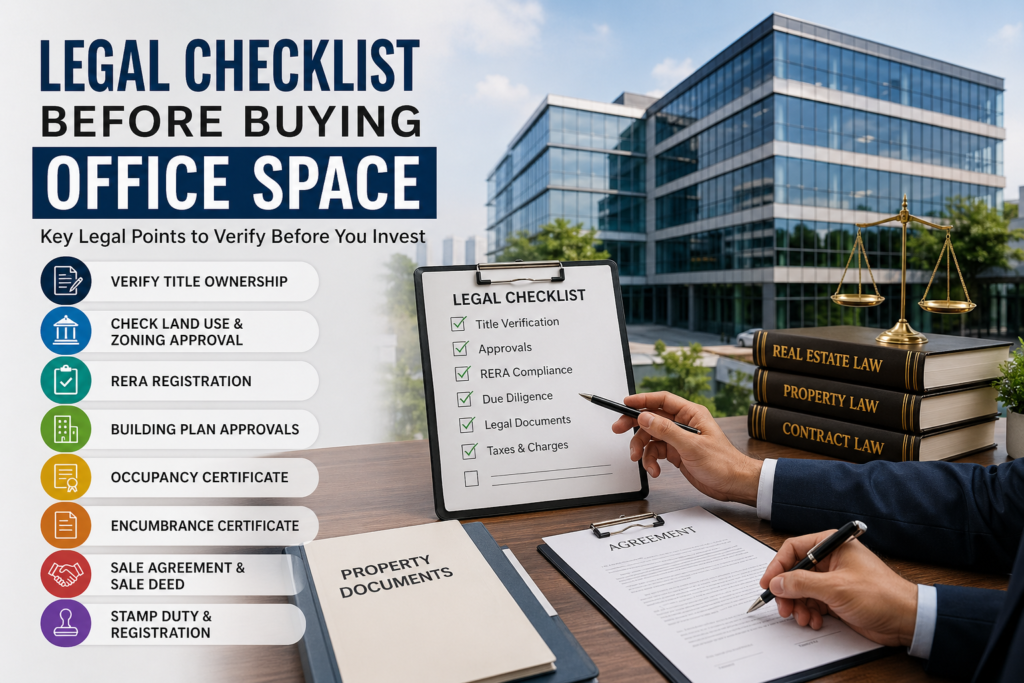
Buying commercial office space isn’t just about location and price—it’s about legal clarity, risk protection, and future scalability. Missing a single document can lead to disputes, delayed possession, or even financial loss. Here’s a practical, no-fluff legal checklist to follow before you sign anything.
1. Verify Title Ownership
Start with the basics: who actually owns the property?
- Ask for the Title Deed and verify the chain of ownership (last 20–30 years).
- Ensure the seller has clear, marketable title with no disputes.
- Cross-check with local land records.
2. Check Land Use & Zoning Approval
Not every plot can legally be used as office space.
- Confirm the land is approved for commercial use.
- Verify zoning regulations with local municipal authorities.
- Avoid residential-to-commercial conversions unless legally approved.
3. RERA Registration (Mandatory for New Projects)
Under the Real Estate (Regulation and Development) Act, 2016:
- Ensure the project is registered on your state’s RERA website.
- Check builder details, project timelines, and approvals.
- Avoid projects not listed—this is a major red flag.
4. Building Plan Approvals
- Verify that construction is approved by local authorities.
- Check sanctioned building plans and compare them with actual construction.
- Unauthorized floors or modifications can lead to penalties or demolition.
5. Occupancy Certificate (OC) & Completion Certificate (CC)
- OC confirms the building is safe for occupancy.
- CC confirms construction is completed as per approved plans.
Without these, you may face legal and utility issues.
6. Encumbrance Certificate (EC)
This document confirms whether the property has any loans or legal dues.
- Obtain EC for at least the last 15 years.
- Ensure there are no mortgages, liens, or legal claims.
7. Sale Agreement & Sale Deed
These define your ownership rights.
- Review all clauses carefully—payment schedule, possession date, penalties.
- Ensure the final Sale Deed is registered at the sub-registrar office.
- Never rely on verbal commitments.
8. Check Developer Credentials
- Review past projects and delivery timelines.
- Look for litigation history.
- A reputed builder reduces legal risk significantly.
9. Utility & Compliance Clearances
Make sure the property has:
- Electricity & water approvals
- Fire safety clearance
- Environmental clearance (for large projects)
Missing approvals can disrupt operations later.
10. Stamp Duty & Registration Charges
- Ensure proper payment of stamp duty as per state laws.
- Underpayment can lead to penalties and legal complications.
11. Lease Terms (If Buying for Rental Income)
If your goal is rental yield:
- Review lease agreements with tenants (if pre-leased).
- Check lock-in period, escalation clauses, and exit terms.
12. GST & Tax Implications
- Commercial properties may attract GST (for under-construction projects).
- Understand input tax credit benefits and long-term tax impact.
Common Mistakes to Avoid
- Ignoring legal due diligence to “save time”
- Trusting builder promises without documentation
- Not consulting a real estate lawyer
- Overlooking hidden liabilities in EC
FAQs – Legal Checklist Before Buying Office Space
1. Is RERA mandatory for commercial office spaces?
Yes, if it’s a new project. Under the Real Estate (Regulation and Development) Act, 2016, most commercial projects must be registered.
2. What happens if I buy property without an Occupancy Certificate?
You may face issues with utilities, resale, and even legal penalties. Banks may also refuse loans.
3. How do I verify if the property has legal disputes?
Check the Encumbrance Certificate, court records, and consult a property lawyer for deeper verification.
4. Can I convert residential property into office space?
Only if local zoning laws allow it and you obtain proper approvals.
5. What is the most important legal document?
The Title Deed—it proves ownership. Without clear title, the deal is risky.
6. Should I hire a lawyer for property purchase?
Absolutely. A real estate lawyer can identify hidden risks that are easy to miss.
7. Is GST applicable on office space?
Yes, for under-construction properties. Ready-to-move-in properties usually don’t attract GST.
8. What is an Encumbrance Certificate?
It confirms whether the property is free from loans or legal liabilities.