
Introduction
Real estate has always been one of India’s most trusted investment options. However, investor priorities are changing in 2026. While some buyers want a steady monthly income through rental earnings, others are focused on increasing their property’s value over time.
This raises an important question:
Should you invest for rental yield or capital appreciation?
The answer depends on your financial goals, investment horizon, and risk appetite. Understanding both concepts can help you make smarter investment decisions and maximize long-term wealth.
In this guide, we’ll explain the differences between rental yield and capital appreciation, compare their benefits, and explore what Indian investors are choosing in 2026.
What is Rental Yield?
Rental yield is the annual income generated from a property compared to its purchase price. It measures how efficiently your property generates regular income.
Formula
Rental Yield (%) = Annual Rental Income ÷ Property Value × 100
Example
Suppose you purchase a commercial office space for ₹80 lakhs.
Annual rental income: ₹6.4 lakhs
Rental Yield:
₹6.4 Lakhs ÷ ₹80 Lakhs × 100 = 8%
A higher rental yield means better monthly cash flow.
What is Capital Appreciation?
Capital appreciation refers to the increase in a property’s market value over time.
For example,
If you buy a commercial office unit for ₹80 lakhs and sell it after five years for ₹1.2 crore, the appreciation is ₹40 lakhs.
Unlike rental income, capital appreciation creates wealth when you sell the property.
Rental Yield vs Capital Appreciation
| Factor | Rental Yield | Capital Appreciation |
|---|---|---|
| Returns | Regular monthly income | Profit on resale |
| Investment Goal | Passive income | Long-term wealth creation |
| Cash Flow | Immediate | Future gains |
| Risk | Depends on occupancy | Depends on market growth |
| Best For | Income-focused investors | Growth-focused investors |
| Liquidity | Regular income | One-time profit at sale |
Why Rental Yield Is Becoming More Popular in 2026
Many Indian investors now prioritize stable cash flow over waiting several years for property appreciation.
Key reasons include:
1. Predictable Monthly Income
Commercial properties leased to established businesses provide consistent rental income.
2. Inflation Protection
Rental agreements often include periodic rent escalations, helping investors keep pace with inflation.
3. Lower Vacancy in Prime Commercial Locations
Grade-A office spaces in major business districts continue to attract strong tenant demand.
4. Financial Stability
Monthly rental income can help cover EMIs or serve as an additional source of income.
Why Capital Appreciation Still Matters
Although rental income is attractive, capital appreciation remains a major wealth-building strategy.
Strong Infrastructure Growth
Areas near metro stations, IT corridors, and business hubs often experience significant price appreciation.
Long-Term Wealth Creation
Property values generally increase over time when supported by strong economic development and demand.
Portfolio Growth
Capital appreciation boosts your net worth without requiring additional investments.
What Indian Investors Prefer in 2026
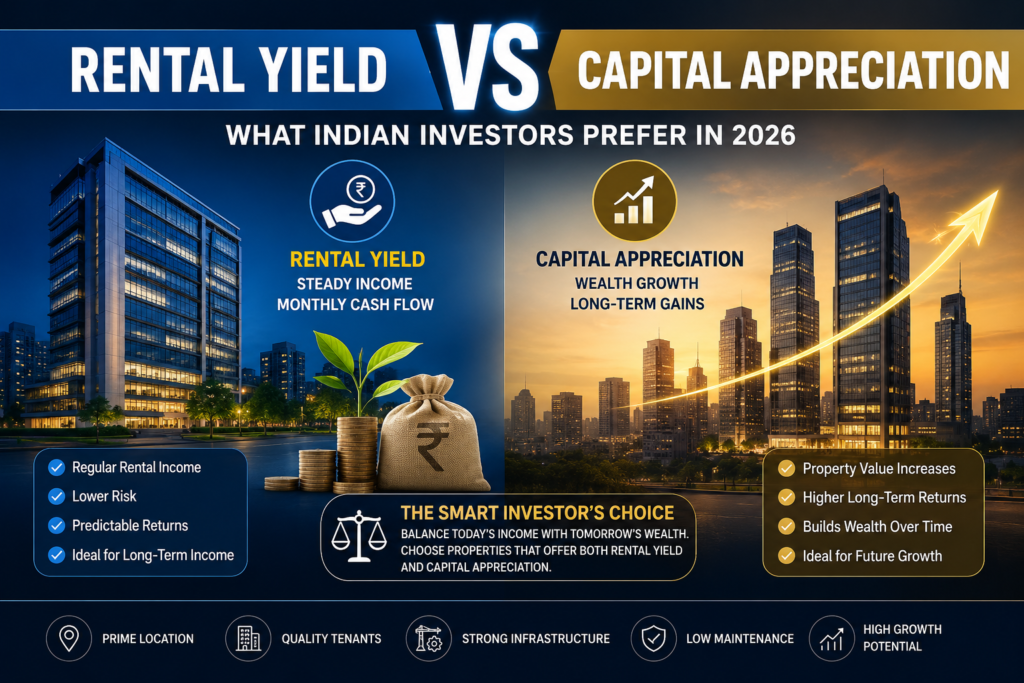
Market trends suggest investors are increasingly looking for a balance between rental income and capital growth rather than choosing one over the other.
Today’s investors prefer commercial properties that offer:
- Stable rental income
- High-quality tenants
- Strategic business locations
- Strong long-term appreciation potential
- Low maintenance requirements
This balanced approach helps generate immediate cash flow while building wealth over time.
Commercial Office Spaces: Offering the Best of Both Worlds
Commercial office spaces have become one of the most attractive real estate segments in 2026.
Here’s why:
Attractive Rental Returns
Commercial office spaces often provide higher rental yields than many residential properties.
Growing Business Demand
As companies expand, demand for premium office spaces remains strong in established business locations.
Long-Term Appreciation
Business districts with ongoing infrastructure development continue to see property value growth.
Professional Tenants
Commercial leases are generally longer, offering more stable occupancy and predictable income.
Which Strategy Is Right for You?
Choose Rental Yield If You:
- Want regular monthly income
- Are planning for retirement income
- Prefer predictable cash flow
- Want passive income from real estate
Choose Capital Appreciation If You:
- Have a long investment horizon
- Can wait for future gains
- Want to build long-term wealth
- Are comfortable with market fluctuations
Choose Both If You:
The most successful investors often select properties that provide both rental income and appreciation potential. Commercial office spaces in prime business districts frequently offer this combination.
Investment Tips for 2026
Before investing, consider these factors:
- Research location growth potential.
- Evaluate rental demand in the area.
- Check infrastructure projects nearby.
- Assess the developer’s reputation.
- Understand lease terms and tenant quality.
- Compare rental yields across property types.
- Consider long-term appreciation prospects.
- Diversify your investment portfolio.
Common Mistakes to Avoid
- Focusing only on purchase price.
- Ignoring rental demand.
- Overlooking location quality.
- Buying without market research.
- Choosing properties with poor connectivity.
- Ignoring maintenance and operating costs.
- Expecting unrealistic appreciation.
Final Thoughts
The debate between rental yield and capital appreciation doesn’t have a one-size-fits-all answer. In 2026, Indian investors are increasingly seeking investments that deliver both steady income and long-term value growth.
Commercial office spaces, especially those in established business hubs with strong infrastructure and quality tenants, are well-positioned to meet these expectations. By aligning your investment strategy with your financial goals and conducting thorough market research, you can build a real estate portfolio that supports both immediate income and future wealth creation.
Frequently Asked Questions (FAQs)
1. What is the difference between rental yield and capital appreciation?
Rental yield is the annual income earned from renting out a property, while capital appreciation is the increase in the property’s market value over time.
2. Which offers better returns in 2026?
There is no universal answer. Investors seeking regular income may prioritize rental yield, while those focused on long-term wealth may prefer capital appreciation. Many aim for properties that provide both.
3. Are commercial office spaces a good investment in India?
Commercial office spaces can offer attractive rental income and long-term appreciation, particularly in well-connected business districts with strong tenant demand.
4. How can I calculate rental yield?
Use this formula:
Rental Yield (%) = Annual Rental Income ÷ Property Value × 100
5. What factors influence capital appreciation?
Location, infrastructure development, business activity, connectivity, demand, and overall market conditions all play important roles.
6. Is rental income taxable in India?
Yes. Rental income is generally taxable under Indian tax laws, subject to applicable deductions and exemptions. It’s advisable to consult a qualified tax professional for guidance.