
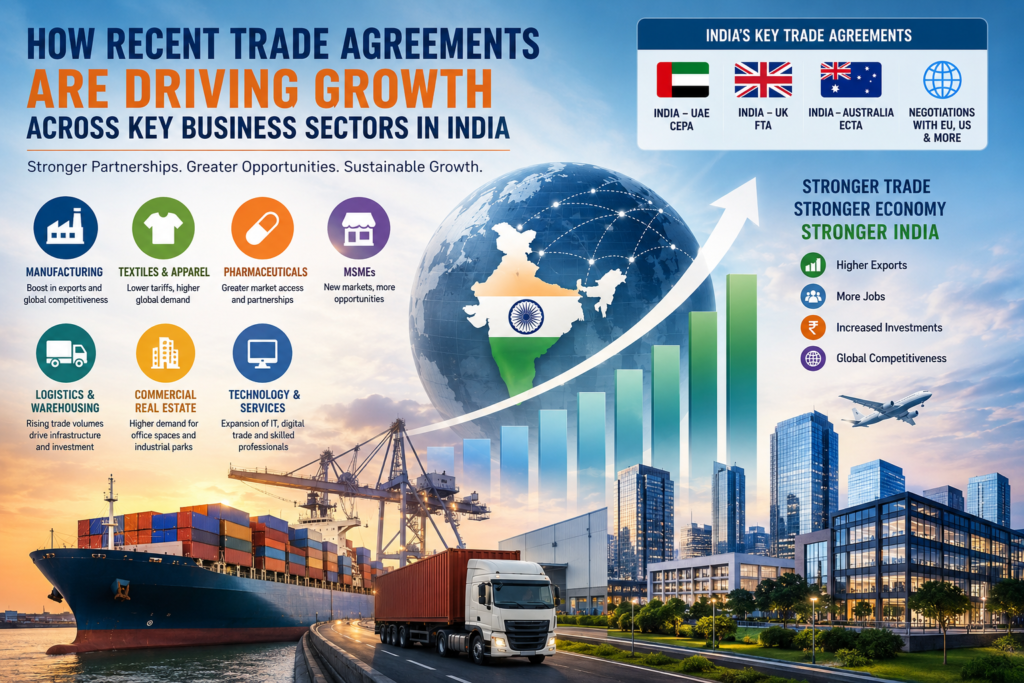
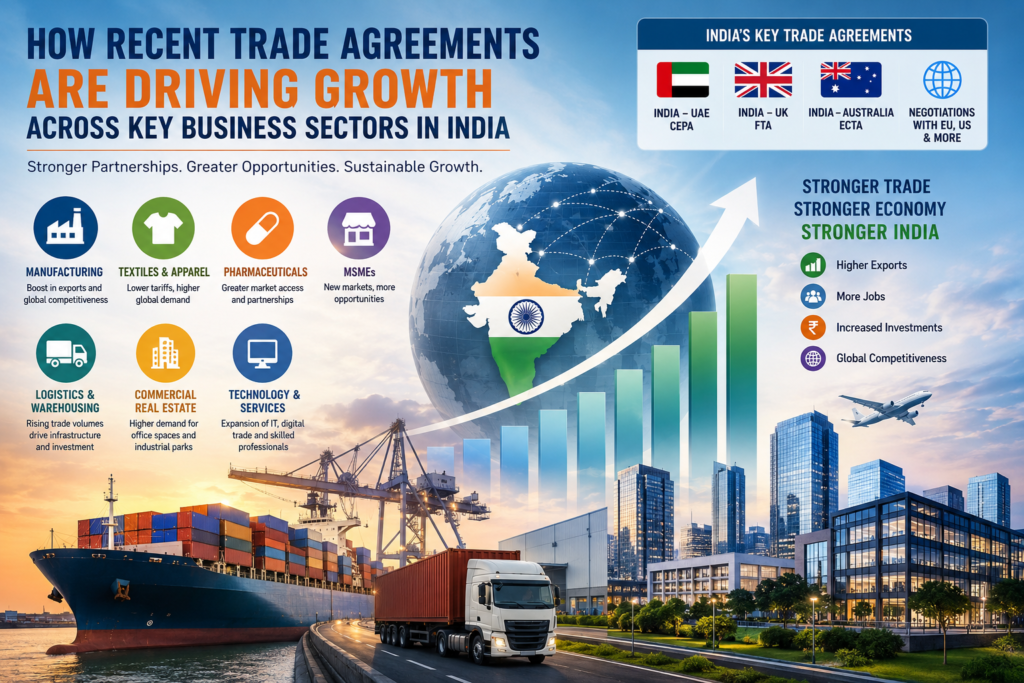
India’s global trade strategy is entering a new phase. Over the last few years, the country has signed and expanded multiple Free Trade Agreements (FTAs) and Comprehensive Economic Partnership Agreements (CEPAs) with major economies including the UAE, the UK, Australia, and other emerging trade partners.
These agreements are not just diplomatic milestones — they are reshaping India’s business landscape by opening new export markets, attracting foreign investment, boosting manufacturing, and strengthening India’s position in global supply chains.
From textiles and pharmaceuticals to technology, logistics, agriculture, and commercial real estate, recent trade agreements are creating opportunities across multiple sectors.
India’s Growing Trade Network
India has aggressively expanded its international trade partnerships to increase exports and reduce dependency on limited markets. Recent agreements include:
- India–UAE CEPA
- India–UK Free Trade Agreement
- India–Australia ECTA
- Ongoing negotiations with the EU, US, Oman, Peru, and Chile
These agreements aim to reduce tariffs, improve market access, simplify customs procedures, and encourage cross-border investments.
According to reports, India is targeting nearly $1 trillion in exports by FY27 as these trade agreements begin delivering economic impact.
1. Manufacturing Sector Sees Strong Export Momentum
India’s manufacturing industry is one of the biggest beneficiaries of recent FTAs.
Reduced tariffs allow Indian products to become more price competitive in international markets. Industries such as engineering goods, machinery, auto components, electronics, and industrial equipment are seeing growing demand overseas.
The India–UK trade agreement, for example, provides zero-duty access for a significant portion of Indian exports, improving competitiveness for Indian manufacturers.
Key Growth Drivers:
- Lower export duties
- Easier customs procedures
- Better global market access
- Increased international partnerships
- Supply chain diversification away from China
As global companies diversify sourcing strategies, India is positioning itself as a major manufacturing hub.
2. Textile & Apparel Industry Gains Global Advantage
India’s textile and apparel sector is witnessing renewed growth due to tariff reductions in major markets.
Recent agreements with the UK and Middle Eastern countries are helping Indian textile exporters compete more effectively against countries like Bangladesh and Vietnam.
Reports suggest that sectors like:
- textiles,
- leather,
- footwear,
- sports goods,
- and garments
are receiving significant duty benefits under new agreements.
Impact on the Industry:
- Higher export volumes
- Expansion of MSMEs
- Increased employment generation
- Growth in textile manufacturing clusters
This is especially important for labor-intensive industries that support millions of jobs across India.
3. Pharmaceutical Sector Expands International Reach
India is already one of the world’s largest pharmaceutical exporters. Trade agreements are now making Indian medicines more accessible globally.
Several agreements focus on:
- faster regulatory approvals,
- simplified compliance,
- improved intellectual property frameworks,
- and smoother pharmaceutical exports.
The India–UAE CEPA and India–UK FTA are expected to strengthen India’s pharmaceutical exports significantly.
Benefits for Pharma Companies:
- Faster market entry
- Reduced trade barriers
- Expanded exports
- Increased global partnerships
- Higher investment in R&D
India’s pharmaceutical manufacturing ecosystem is likely to grow further as international healthcare demand rises.
4. MSMEs Are Getting New Global Opportunities
Micro, Small, and Medium Enterprises (MSMEs) are emerging as major beneficiaries of India’s trade expansion.
Trade agreements reduce export complexities and provide easier access to foreign buyers, especially for:
- food processing,
- handicrafts,
- engineering products,
- marine exports,
- tea and coffee,
- and specialty manufacturing.
Industry reports highlight that MSMEs could play a central role in export growth under new trade frameworks.
Why This Matters:
MSMEs contribute significantly to:
- employment,
- manufacturing output,
- and exports.
Trade agreements help smaller businesses compete internationally without requiring massive capital investment.
5. Logistics & Warehousing Sector Experiences Rapid Growth
As exports rise, logistics demand automatically increases.
India’s trade agreements are fueling demand for:
- ports,
- cargo handling,
- warehousing,
- industrial parks,
- freight corridors,
- and transportation infrastructure.
Growing international trade volumes require stronger supply chain networks and faster distribution systems.
Emerging Opportunities:
- Multi-modal logistics parks
- Cold storage facilities
- Export-oriented warehousing
- Industrial corridors
- Smart logistics hubs
This is also increasing demand for commercial and industrial real estate across key business regions.
6. Commercial Real Estate Benefits from Trade Expansion
Trade growth directly impacts office space demand, industrial parks, and commercial infrastructure.
As global companies expand operations in India, demand is increasing for:
- Grade-A office spaces,
- IT parks,
- industrial zones,
- logistics hubs,
- and business districts.
Cities like Hyderabad, Bengaluru, Pune, and Chennai are attracting international businesses due to:
- infrastructure development,
- skilled workforce,
- and export-oriented growth.
Hyderabad’s Growing Role
Hyderabad is rapidly emerging as a major business and investment destination due to:
- strong IT infrastructure,
- pharma manufacturing,
- global capability centers,
- and logistics connectivity.
Trade agreements can further strengthen Hyderabad’s position as a global commercial and export hub.
7. Technology & Services Sector Gains International Access
India’s IT and professional services sector also benefits from modern trade agreements.
Many new agreements include:
- digital trade provisions,
- professional mobility,
- financial technology collaboration,
- and service sector access.
The India–UK FTA includes provisions supporting skilled professionals and easier mobility for Indian workers.
Opportunities for India’s Service Economy:
- IT exports
- SaaS companies
- Fintech expansion
- Consulting services
- Engineering services
- Remote global workforce integration
India’s digital economy is expected to benefit significantly as cross-border service demand grows.
Challenges Businesses Must Address
While trade agreements create opportunities, businesses must also prepare for increased competition.
Key challenges include:
- maintaining global quality standards,
- improving supply chain efficiency,
- faster delivery timelines,
- export compliance,
- and competitive pricing.
Industry experts have also noted that many Indian businesses are still underutilizing available FTA benefits.
To maximize growth, companies must:
- understand tariff structures,
- leverage export incentives,
- and build international partnerships strategically.
The Future of India’s Trade-Led Growth
India’s trade agreements are becoming powerful economic growth engines.
With multiple negotiations underway and global companies looking for reliable manufacturing and business destinations, India is positioning itself as a long-term global trade leader.
The biggest beneficiaries are expected to include:
- manufacturing,
- logistics,
- commercial real estate,
- technology,
- pharmaceuticals,
- and export-focused MSMEs.
As these agreements mature, India could witness:
- stronger GDP growth,
- higher foreign investment,
- improved employment,
- and expansion across major business sectors.
Conclusion
Recent trade agreements are transforming India’s economic landscape by creating new global opportunities for businesses across industries.
From export-driven manufacturing growth to rising demand for logistics infrastructure and commercial real estate, the impact is visible across the economy.
As India strengthens its global trade presence, businesses that adapt quickly to international markets, supply chain standards, and export opportunities are likely to lead the next phase of growth.
For investors, entrepreneurs, and commercial real estate stakeholders, this evolving trade ecosystem presents one of the strongest long-term growth opportunities in India’s modern economic journey.