
Commercial real estate is no longer something only big corporations or ultra-rich investors can access. Today, even first-time investors are exploring commercial spaces because of the steady rental income, long-term appreciation, and growing demand in developing business hubs like Hyderabad.
If you’ve been thinking about entering the commercial real estate market but don’t know where to begin, this guide will help you understand the basics in a simple and practical way.
What Is Commercial Real Estate?
Commercial real estate refers to properties used for business purposes rather than living spaces. These include:
- Office spaces
- Retail shops
- Business centers
- Co-working spaces
- Commercial towers
- Mixed-use developments
Unlike residential properties, commercial spaces are mainly purchased to generate rental income and long-term value growth.
Why Are More Investors Choosing Commercial Properties?
One of the biggest reasons people move towards commercial investments is predictable cash flow. Businesses usually sign longer lease agreements compared to residential tenants, which creates more stability for property owners.
Here are some major advantages:
1. Higher Rental Yield
Commercial properties often provide better rental returns compared to residential apartments.
2. Long-Term Appreciation
Locations with infrastructure growth, IT expansion, metro connectivity, and business demand tend to appreciate faster over time.
3. Professional Tenants
Commercial tenants usually maintain the property better because it directly impacts their business image.
4. Passive Monthly Income
Once leased, commercial properties can generate consistent monthly rental income.
Step-by-Step Guide to Start Investing in Commercial Real Estate
Step 1: Understand Your Budget
Before investing, decide how much you are comfortable investing initially. Commercial properties come in different investment ranges today, including:
- Full ownership spaces
- Fractional ownership models
- Pre-leased properties
- Under-construction commercial projects
Many beginners start with smaller commercial units and gradually expand their portfolio.
Step 2: Choose the Right Location
In commercial real estate, location plays the biggest role in future growth.
Look for areas with:
- IT company expansion
- Metro connectivity
- ORR access
- Growing business demand
- Upcoming infrastructure projects
- High footfall potential
For example, areas like Kokapet and Neopolis are gaining attention because of their connectivity to Financial District, Gachibowli, and the airport corridor.
Step 3: Analyze Rental Demand
Before purchasing any commercial space, ask:
- Who will rent this property?
- Is the area attracting businesses?
- What type of companies are entering the location?
- Is there future office demand?
A good investment is not just about buying property — it’s about buying where businesses want to operate.
Step 4: Understand ROI Before Investing
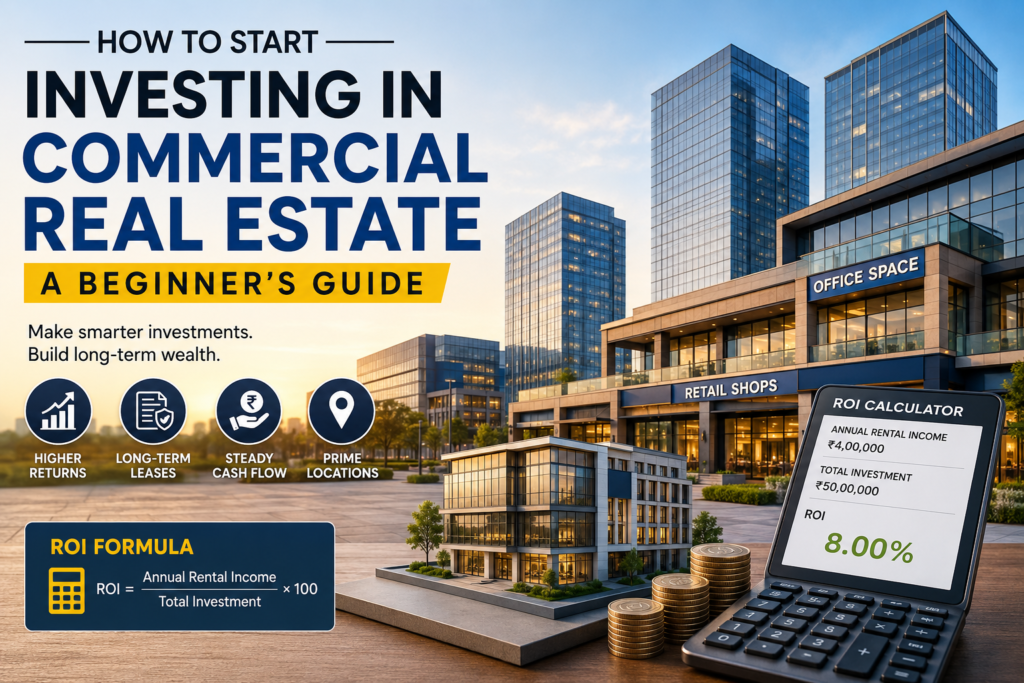
ROI stands for Return on Investment. It helps investors understand how profitable a property can be.
A simple ROI formula looks like this:
ROI=Total InvestmentAnnual Rental Income×100
Example:
If:
- Property Cost = ₹50 Lakhs
- Annual Rental Income = ₹4 Lakhs
Then:
ROI = (4,00,000 ÷ 50,00,000) × 100 = 8%
An ROI calculator helps investors compare different commercial opportunities before making a decision.
Key Things Beginners Should Check Before Buying
Property Documents
Always verify:
- Ownership documents
- Approvals
- RERA registration
- Land permissions
- Builder credibility
Builder Reputation
A trusted developer reduces investment risk significantly.
Connectivity
Commercial properties perform better when they are near:
- IT hubs
- Main roads
- Metro stations
- Business districts
- Airports
Future Development Potential
Areas with planned infrastructure usually see stronger appreciation in the future.
Common Mistakes First-Time Investors Make
Choosing Low-Demand Locations
Cheap property is not always a smart investment if business demand is weak.
Ignoring Maintenance Costs
Commercial spaces may include:
- Maintenance charges
- Common area fees
- Property taxes
These should be considered while calculating profits.
Investing Without ROI Analysis
Many people buy based only on emotions or marketing hype instead of numbers.
Is Commercial Real Estate Safe for Beginners?
Yes — if approached carefully.
The key is:
- Choosing the right location
- Understanding demand
- Calculating ROI properly
- Investing with long-term vision
Commercial real estate usually performs best when investors stay patient and focus on growth corridors.
Why Hyderabad Is Becoming a Commercial Investment Hotspot
Hyderabad has emerged as one of India’s fastest-growing commercial destinations due to:
- IT industry growth
- Global company expansion
- Infrastructure development
- ORR connectivity
- Metro expansion
- Business-friendly ecosystem
Locations like Financial District, Gachibowli, Kokapet, and Neopolis are witnessing increasing commercial demand from startups, enterprises, and retail brands.
Final Thoughts
Starting your commercial real estate journey may feel complicated at first, but understanding the basics makes the process much easier. Focus on location quality, rental demand, and ROI instead of short-term hype.
Commercial properties can become a strong long-term asset when chosen wisely. Whether you are looking for passive income, future appreciation, or portfolio diversification, commercial real estate offers opportunities for both beginners and experienced investors.
The smartest investments are usually made in locations that are still growing today but becoming business hubs tomorrow.
1. What is commercial real estate investment?
Commercial real estate investment means purchasing properties used for business purposes such as office spaces, retail shops, commercial towers, or co-working spaces to earn rental income and long-term appreciation.
2. Is commercial real estate a good investment for beginners?
Yes, commercial real estate can be a good option for beginners if they choose the right location, analyze ROI, and invest in growing business hubs with strong rental demand.
3. How much money is needed to invest in commercial property?
The investment amount depends on the project and location. Today, investors can start with smaller commercial units or fractional ownership opportunities instead of purchasing an entire building.
4. What is ROI in commercial real estate?
ROI (Return on Investment) measures the profit generated from a property compared to the total investment amount.
ROI=Total InvestmentAnnual Rental Income×100
A higher ROI generally indicates better income potential.
5. Which locations are best for commercial investment in Hyderabad?
Growing areas like Kokapet, Financial District, Gachibowli, and Neopolis are becoming popular because of IT growth, ORR connectivity, and infrastructure development.
6. What are the benefits of investing in commercial properties?
Some major benefits include:
- Higher rental income
- Long-term appreciation
- Professional tenants
- Stable lease agreements
- Passive monthly income opportunities
7. How do I calculate rental yield in commercial real estate?
Rental yield is calculated by dividing annual rental income by the total property investment.
Rental Yield=Property ValueAnnual Rental Income×100
8. What should beginners check before buying commercial property?
Beginners should verify:
- Property approvals
- Builder reputation
- Location growth potential
- Rental demand
- Connectivity
- Legal documentation
9. Why is Hyderabad attracting commercial investors?
Hyderabad is attracting investors due to rapid IT expansion, metro connectivity, airport access, business-friendly policies, and emerging commercial corridors.
10. Is commercial real estate better than residential investment?
Commercial real estate often offers higher rental yields and longer lease periods compared to residential properties, though it may require better market understanding and planning.