
Introduction
For years, commercial real estate was considered a space only for high-net-worth individuals and large corporations. Owning a premium office space in fast-growing business hubs like Kokapet or Financial District required massive capital, industry connections, and long-term financial commitment.
But the market is changing.
Today, fractional commercial investment is opening the doors for everyday investors to participate in high-value commercial assets with smaller investment amounts. Instead of purchasing an entire property worth crores, investors can now own a share in premium commercial spaces and enjoy rental income, appreciation potential, and asset ownership benefits.
This shift is becoming one of the fastest-growing trends in modern real estate investing.
What Is Fractional Commercial Investment?
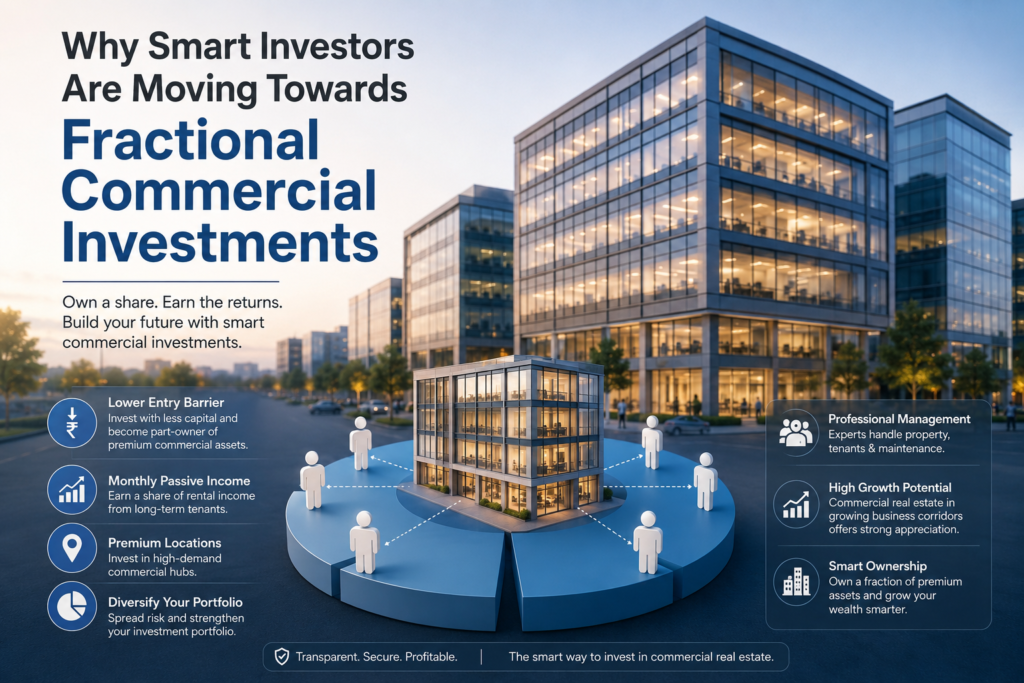
Fractional commercial investment is a model where multiple investors collectively own a commercial property.
Instead of:
❌ One person buying an entire office space
It becomes:
✅ Multiple investors owning portions of a premium commercial asset
Each investor contributes a smaller amount and receives proportional benefits such as:
- Monthly rental income
- Appreciation in property value
- Ownership share
- Access to Grade-A commercial properties
This model allows people to enter the commercial real estate market without requiring huge capital.
Why Investors Are Choosing Fractional Commercial Investments
1. Lower Entry Barrier
Traditional commercial investments often require ₹70 lakhs to several crores.
Fractional investment changes this completely.
Now investors can start with comparatively affordable amounts and still become part-owners of premium office assets in growing business corridors.
This creates opportunities for:
- Salaried professionals
- Business owners
- Young investors
- First-time real estate buyers
who previously could not access commercial real estate.
2. Monthly Passive Income Potential
One major reason investors are moving toward commercial assets is consistent rental income.
Unlike many residential properties that may remain vacant or generate lower yields, commercial spaces often provide:
- Long-term tenants
- Stable lease structures
- Better rental potential
For many investors, this creates an additional monthly income source alongside their primary earnings.
3. Commercial Real Estate Is Growing Rapidly
Business districts around Hyderabad are expanding faster than ever.
Areas like:
- Neopolis
- Kokapet
- Financial District
- ORR Exit No. 1
are attracting:
- IT companies
- Startups
- Corporate offices
- Global business brands
As demand for office space increases, commercial properties in strategic locations continue gaining attention from investors.
Key Benefits of Fractional Commercial Investments
Diversification
Instead of locking all savings into one residential asset, investors can diversify into commercial real estate.
This helps create a balanced investment portfolio.
Professional Asset Management
Many fractional investment models include professional management teams that handle:
- Tenant management
- Property maintenance
- Documentation
- Rental collection
This reduces operational burden for investors.
Ownership in Premium Assets
Fractional investment allows people to participate in premium-grade projects that may otherwise be financially inaccessible.
This includes:
- IT parks
- Business centers
- High-demand office spaces
- Corporate towers
Better Utilization of Savings
Many people keep large amounts in:
- Savings accounts
- Fixed deposits
- Low-growth instruments
Fractional commercial investment provides an alternative for people looking to explore asset-backed opportunities with long-term potential.
Why Hyderabad Is Becoming a Hotspot
Hyderabad has emerged as one of India’s strongest commercial real estate markets due to:
- Rapid IT expansion
- Infrastructure growth
- ORR connectivity
- Corporate migration
- Growing startup ecosystem
Micro-markets like Kokapet and Neopolis are now being viewed as future-focused business destinations.
As infrastructure and office demand continue growing, investors are increasingly exploring commercial opportunities in these corridors.
Who Should Consider Fractional Commercial Investments?
This model can be suitable for:
Salaried Professionals
People looking for an additional income source beyond salary.
Young Investors
Those wanting to enter real estate without massive capital.
Business Owners
Investors looking to diversify beyond traditional business assets.
Long-Term Wealth Builders
People seeking asset-backed opportunities with rental potential.
Important Things to Check Before Investing
Before investing in any fractional commercial project, always evaluate:
Location Quality
Choose fast-developing business zones with future growth potential.
Tenant Strength
Stable tenants improve rental consistency.
Builder Reputation
Research project credibility and delivery track record.
Legal Documentation
Verify ownership structure and agreements carefully.
Exit Options
Understand resale and liquidity possibilities.
The Future of Commercial Investing
The way people invest in real estate is evolving.
Modern investors are now focusing on:
- Smart ownership models
- Income-generating assets
- Flexible entry opportunities
- Long-term commercial growth
Fractional commercial investment is becoming a bridge between traditional real estate and modern investment accessibility.
As commercial hubs continue expanding, this model is expected to play a major role in shaping the next generation of real estate investors.
Conclusion
Fractional commercial investment is changing how people participate in premium real estate opportunities.
It offers:
✅ Lower investment entry
✅ Monthly rental potential
✅ Ownership in premium assets
✅ Exposure to fast-growing commercial corridors
✅ Diversification opportunities
For investors looking beyond traditional options, fractional commercial real estate is emerging as a modern and accessible way to participate in the growth of commercial infrastructure.
Especially in fast-growing markets like Hyderabad, the demand for smart commercial ownership models is only getting stronger.
FAQs – Fractional Commercial Investments
1. What is fractional commercial investment?
Fractional commercial investment is a model where multiple investors collectively own a commercial property. Instead of buying an entire office or commercial space alone, investors purchase a share of the asset and receive proportional ownership benefits.
2. How does fractional ownership work?
A commercial property is divided into smaller ownership portions. Multiple investors contribute capital, and each investor owns a percentage share in the property based on their investment amount.
3. What are the benefits of fractional commercial investment?
Some major benefits include:
- Lower investment entry
- Access to premium commercial properties
- Potential monthly rental income
- Property appreciation opportunities
- Diversification of investment portfolio
- Professionally managed assets
4. Is fractional commercial investment suitable for first-time investors?
Yes. It can be a suitable option for people who want to enter commercial real estate without investing huge amounts typically required for full property ownership.
5. How is commercial investment different from residential investment?
Commercial properties generally focus on business usage such as offices or retail spaces, while residential properties are used for living purposes.
Commercial investments often attract:
- Long-term tenants
- Structured lease agreements
- Higher rental potential compared to many residential assets
6. Can I earn monthly rental income?
Yes. Investors may receive rental income based on:
- Tenant occupancy
- Lease agreements
- Their ownership percentage in the property
Rental structures vary depending on the project.
7. What is the minimum investment required?
The minimum investment depends on the project and developer. Fractional investment models are designed to make premium commercial properties accessible with comparatively smaller investment amounts.
8. Is fractional commercial investment safe?
Like all investments, commercial real estate also involves risks. Investors should always verify:
- Legal documentation
- Builder credibility
- Tenant profile
- Property location
- Exit structure
Conducting proper due diligence is important before investing.
9. Why are investors focusing on areas like Kokapet and Neopolis?
These locations are emerging as major commercial growth corridors due to:
- IT expansion
- ORR connectivity
- Infrastructure development
- Corporate office demand
- Rapid urban growth
This increasing demand is attracting commercial investors.
10. Can I sell my fractional ownership later?
Exit options depend on the investment structure and platform policies. Some projects may allow resale opportunities, while others may have lock-in periods or defined exit timelines.
11. Who manages the property?
In many cases, professional management teams handle:
- Property maintenance
- Tenant management
- Rental collection
- Operational activities
This helps reduce the burden on individual investors.
12. What should I check before investing?
Before investing, always evaluate:
✅ Location potential
✅ Builder reputation
✅ Tenant quality
✅ Legal approvals
✅ Rental structure
✅ Appreciation potential
✅ Exit terms
13. Why is fractional investment becoming popular?
Modern investors are looking for:
- Smart ownership models
- Passive income opportunities
- Asset-backed investments
- Flexible entry into commercial real estate
Fractional investment helps make commercial real estate more accessible to a wider audience.
14. Is commercial real estate a long-term investment?
Commercial real estate is generally considered a medium- to long-term investment, especially for investors looking for rental income and future appreciation potential.